Missing a tooth? Explore dental bridges vs. implants to restore your smile, function, and confidence.
Losing a tooth can impact much more than just your smile. It can affect how you chew your favorite foods, speak clearly, and feel about your overall appearance. If you are exploring options to replace a missing tooth, you have likely come across two leading solutions: dental bridges and dental implants.
Choosing between a dental bridge and an implant is a major decision for your long-term oral health. Both options can restore your smile, but they work in fundamentally different ways. At Woden Dental Care, we believe in providing clear, compassionate, and transparent guidance so you can feel completely confident in your treatment choice.
Here is everything you need to know about comparing dental bridges and implants, including how they work, their key differences, and how to decide which option best fits your lifestyle.
Restore your smile with the right tooth replacement solution. Learn the key differences between dental bridges and dental implants to make an informed decision for your long-term oral health.
Woden Dental Care
What Is a Dental Bridge?
A dental bridge is a non-surgical restoration designed to bridge the gap created by one or more missing teeth.
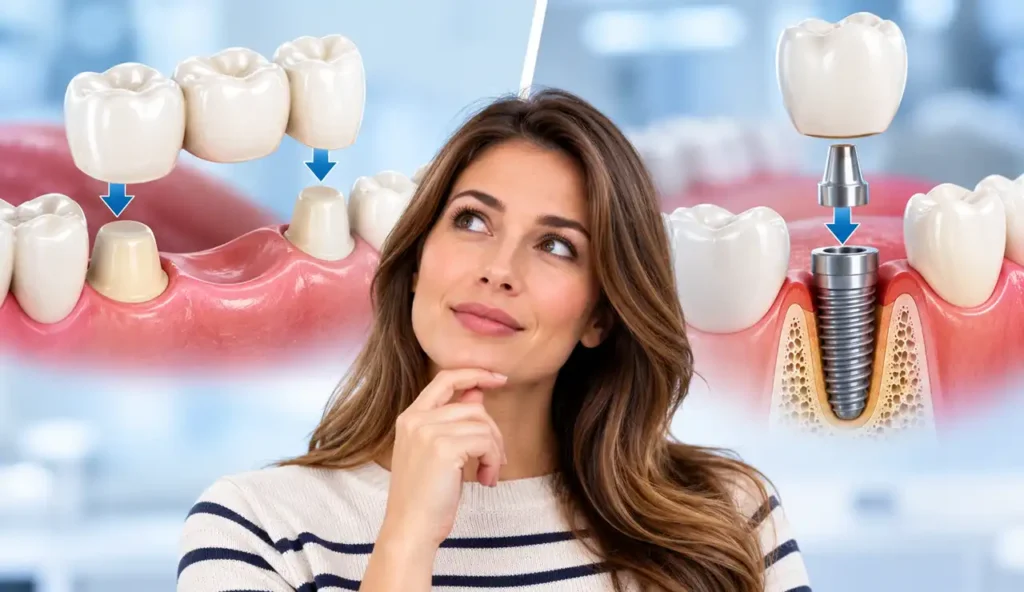
A traditional bridge consists of an artificial tooth held in place by two dental crowns. These crowns are cemented over the healthy natural teeth on either side of the empty space, which act as anchors.
- Advantages of Dental Bridges:
- Faster Treatment Time: The entire process usually requires only two visits over a couple of weeks.
- No Surgery Required: An ideal alternative for patients who prefer to avoid surgical procedures or lack necessary bone density.
- Lower Upfront Cost: Generally more budget-friendly initially and widely covered by most dental insurance plans.
- Considerations:
- Alters Adjacent Teeth: The healthy neighboring teeth must be reshaped to fit the supporting crowns.
- Does Not Prevent Bone Loss: Because a bridge sits above the gumline, it does not stimulate the jawbone underneath.
- Lifespan: Bridges typically last 7 to 15 years before needing maintenance or replacement.
What Is a Dental Implant?
A dental implant is a permanent, standalone tooth replacement that mimics the structure of a natural tooth from root to crown.
The procedure involves placing a biocompatible titanium post directly into the jawbone during a simple surgical visit. Over a few months, the bone fuses around the post in a process called osseointegration. Once fully healed, a custom tooth-colored crown is attached to the top.
- Advantages of Dental Implants:
- Protects Neighboring Teeth: Implants stand independently. Your surrounding healthy teeth remain untouched.
- Preserves Jawbone Health: The implant post acts like a real tooth root, stimulating the jawbone and preventing bone deterioration.
- Exceptional Longevity: With proper daily care and routine checkups, a dental implant post can last a lifetime.
- Natural Look and Feel: Functions just like a real tooth, making eating and speaking seamless.
- Considerations:
- Multi-Step Process: The treatment takes anywhere from 3 to 6 months to allow adequate healing and bone integration.
- Higher Initial Investment: Higher upfront cost compared to a bridge, though often more cost-effective over a lifetime.
- Advantages of Dental Implants:
Dental Bridges vs. Implants: Key Comparisons
When deciding between the two, comparing their main characteristics directly helps simplify the choice:
- Treatment Duration: A dental bridge takes 2 to 3 weeks, while a dental implant requires 3 to 6 months for complete healing.
- Surgical Procedure: Bridges require no surgery, whereas implants involve a minor surgical placement in the jawbone.
- Impact on Surrounding Teeth: Bridges require reshaping neighboring healthy teeth, while implants leave adjacent teeth completely untouched.
- Jawbone Preservation: Bridges do not stimulate the bone beneath the gap. Implants integrate with the jawbone to stimulate growth and prevent structural loss.
- Average Lifespan: Bridges last around 7 to 15 years, while implant posts can last a lifetime with good hygiene.
- Daily Maintenance: Implants are brushed and flossed like natural teeth. Bridges require threader floss or water flossers to clean beneath the artificial tooth.
How to Decide Which Option Is Right for You
When determining whether a bridge or an implant is the best fit, our team at Woden Dental Care evaluates several key factors:
- Your Overall Oral Health: If your neighboring teeth already have large fillings or require crowns, a bridge might solve two problems at once. If adjacent teeth are completely healthy, an implant is usually ideal to preserve them.
- Bone Density: Implants require strong jawbone support. If significant bone loss has occurred, a bone graft may be recommended prior to implant placement, or a bridge may be selected instead.
- Timeline Preferences: If you need a quick restoration for an upcoming event or work commitment, a bridge delivers faster results.
- Long-Term Value: While bridges cost less upfront, implants rarely need replacement, making them a wise long-term investment in your smile.
Restore Your Smile at Woden Dental Care
Every smile is unique, and you do not have to navigate this decision alone. At Woden Dental Care, our friendly team takes the time to listen to your goals, examine your oral health, and create a personalized treatment plan tailored to your needs and budget.
Whether you choose a custom dental bridge or a life-changing dental implant, we are here to make your treatment comfortable, transparent, and stress-free.
Contact Woden Dental Care today to schedule your personalized consultation!
Frequently Asked Questions
Q1. Which lasts longer, a dental bridge or an implant?
A: Dental implants are significantly longer-lasting, often lasting 20 years to a lifetime with proper oral hygiene. Dental bridges typically have a lifespan of 7 to 15 years before they need maintenance or replacement due to wear or decay in supporting teeth.
Q2. Is the dental implant procedure painful?
A: Placement of a dental implant is performed under local anesthesia, ensuring you remain comfortable and pain-free throughout the procedure. Most patients report mild post-treatment tenderness, easily managed with basic over-the-counter pain relievers for a few days.
Q3. Is a dental bridge cheaper than a dental implant?
A: Upfront, a dental bridge is generally less expensive than an implant and is more frequently covered by dental insurance. However, because implants rarely require replacement, they are often more cost-effective over a lifetime.
Q4. Can I get a dental implant if I have been missing a tooth for years?
A: Yes, though long-term missing teeth can cause jawbone shrinkage over time. If bone density has diminished, a routine procedure called a bone graft can rebuild the area, providing a secure foundation for a dental implant.
Q5. How do I clean and maintain a dental bridge vs. an implant?
A: A dental implant is cared for just like a natural tooth with standard brushing and flossing. A dental bridge requires a threader floss or water flosser to clean beneath the false tooth and around anchor crowns.
Q6. Will a bridge or implant look natural in my mouth?
A: Both dental bridges and implants are custom-crafted from high-quality tooth-colored ceramic materials designed to match the shade, shape, and translucency of your natural teeth seamlessly. Both options deliver a beautiful, natural-looking result.